

As we step into 2026, I’ve been reflecting on what this past year meant for Class, and what it signals about the future of learning.
Virtual instructor-led learning is no longer a temporary solution. Instead, it has become an essential part of how organizations train employees, develop leaders, and support learners at scale. Yet too often, live virtual learning still feels like a compromise. Many teams are using tools designed for meetings, then asking instructors to make those tools work for real live instruction.
At Class, we believe live virtual learning deserves better. Learners deserve experiences that feel engaging, collaborative, and worth their attention. Instructors and facilitators deserve tools that support their work, instead of adding friction. And learning leaders deserve clarity into what is working, what’s not, and where to improve.
In 2025, we made strong progress toward that vision. We delivered major product advancements, earned meaningful recognition from industry thought leaders and customers alike, and contributed research that highlights both the momentum behind virtual learning and the gaps that still need to be addressed.
This year, we focused our product work on three areas that are critical to effective live virtual learning: making engagement more visible, improving collaboration in breakout rooms, and expanding analytics that help teams improve outcomes over time.
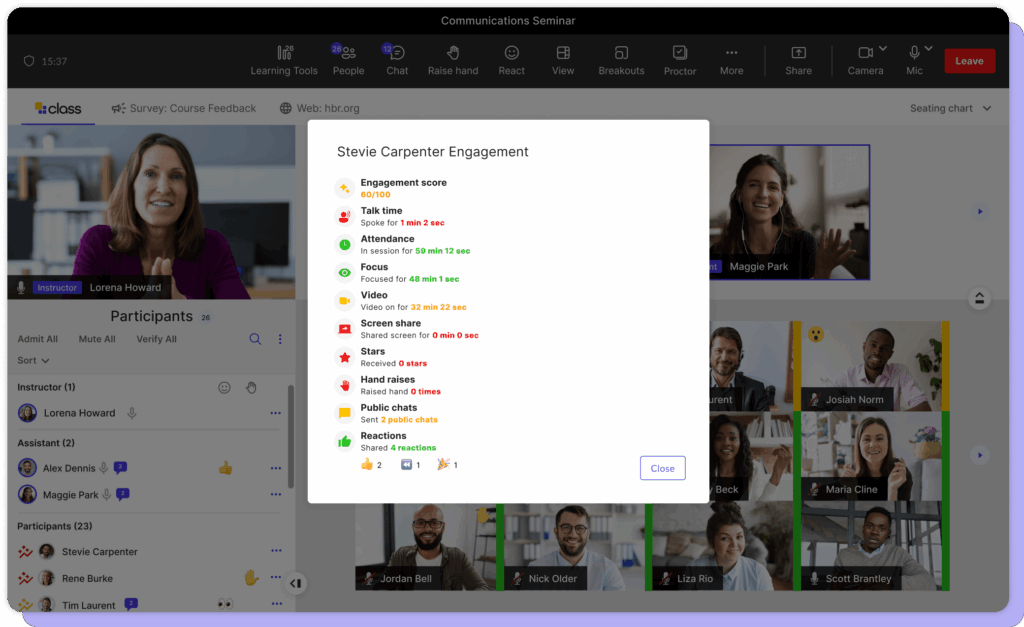
One of the most challenging aspects of teaching or facilitating online is knowing how learners are responding. In a physical room, instructors can quickly identify confusion, distraction, or curiosity. Online, masked behind screens, that context can be harder to recognize.
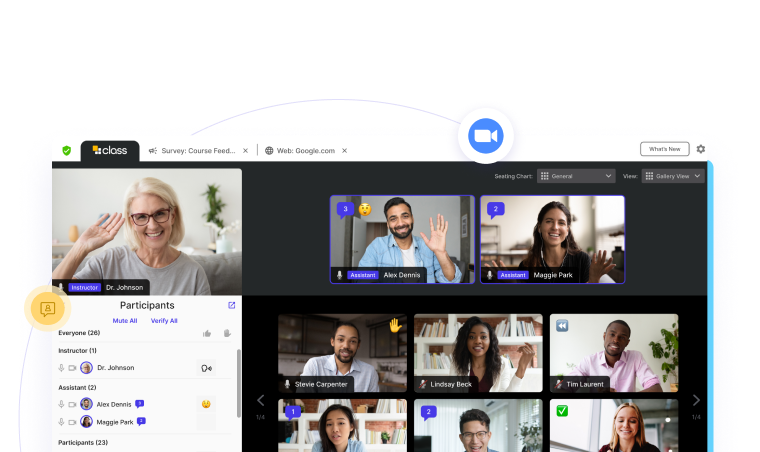
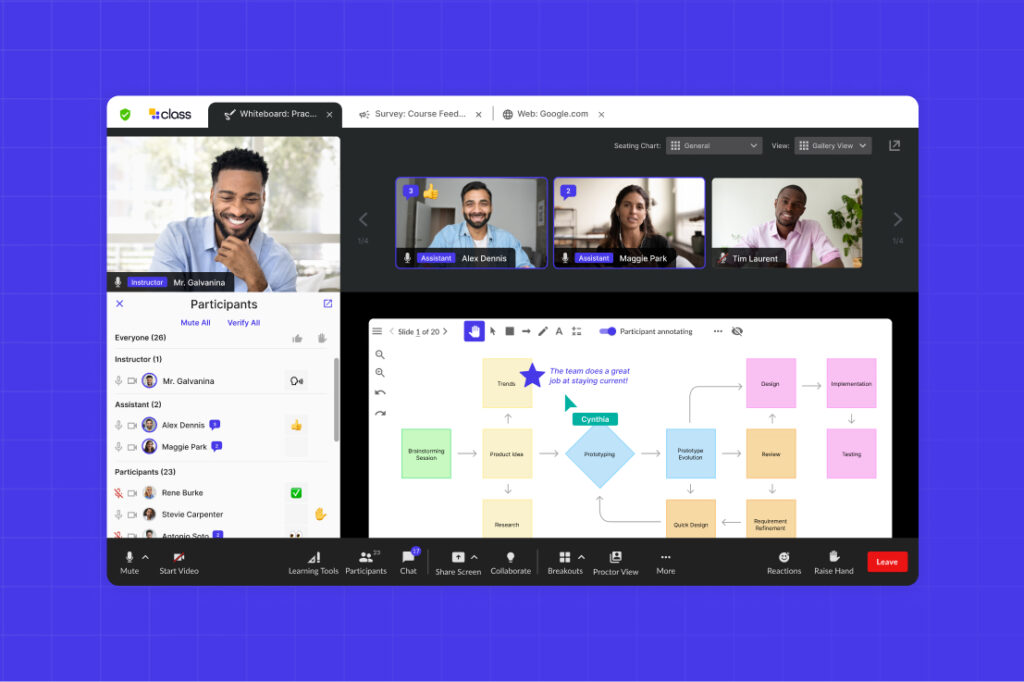
In response, we launched Learner Engagement Scoring, giving facilitators a clear and real-time view of participation throughout a live session. The score is based on signals like attendance, chat activity, talk time, reactions, and focus. It refreshes every 30 seconds, giving facilitators in-the-moment insights and enabling them to adjust their approach during the live session. This helps instructors focus on the learners who need the most support, re-engage them in real time, and offer help before they fall behind.
Breakout rooms are often where learning takes shape. They allow learners to apply concepts, work through challenges together, and build confidence through discussion. They are also one of the most difficult parts of virtual facilitation, because once learners split into groups, instructors often lose visibility into what is happening and where support is needed.
Class breakout rooms were designed to solve that problem from the start. Our intelligent breakout rooms give facilitators a bird’s-eye view of every group, making it possible to monitor multiple rooms simultaneously and stay connected to the full learning experience, even when learners are working in smaller groups.
In 2025, we built on that foundation by adding more insight and more actionable information for facilitators. Instructors can now see an engagement score per breakout room, along with live transcripts that help them understand group discussions without interrupting the conversation. These additions help instructors quickly identify which rooms are thriving, which rooms may be stuck, and where intervention can improve collaboration and learning outcomes.
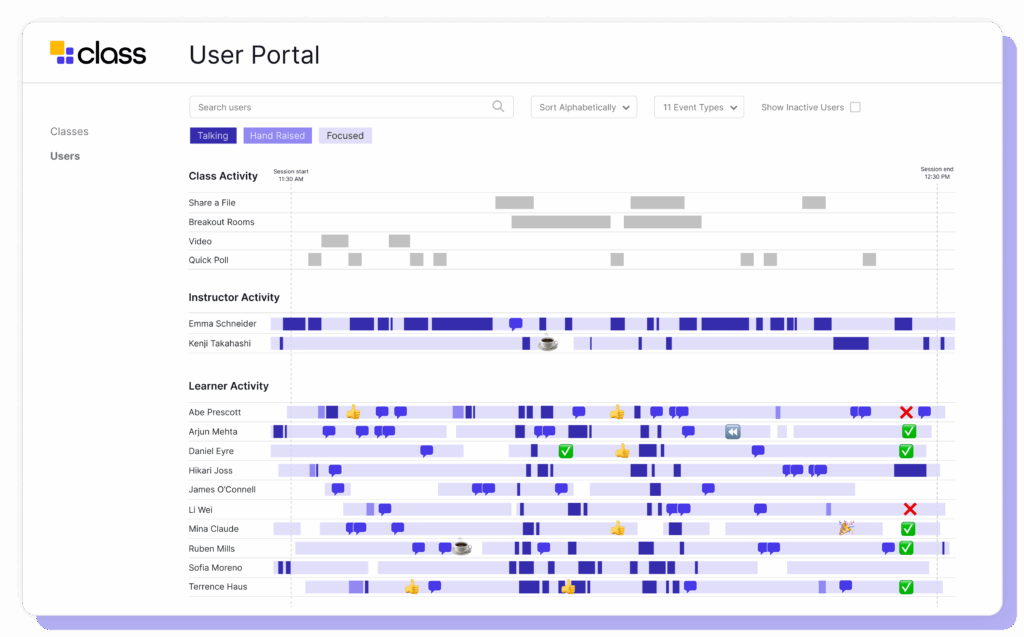
Beyond the live session, organizations need insight into learner participation and learning health over time. In 2025, we continued strengthening our analytics and administrative experience through Class’s post-session data portal, which gives instructors and administrators a clear view of each session, including trends in participation, engagement, and attendance.
The portal supports reflective practice and instructional coaching by helping teams review what happened, identify patterns, and take action. Instructors can drill into detailed metrics from a specific session, and learning leaders can track a learner’s engagement across sessions or courses over time. As Mike at Monash University shared, “With Class, we're able to have data-informed conversations rather than just subjective ones…Class enables us to support teachers and teacher educators in reflecting on what happened, understanding why it happened, and then planning what to do next.”
This visibility makes it easier to provide timely support, refine instruction, and improve outcomes at scale.
As we continued expanding how Class supports instructors and learning leaders with data before, during, and after live virtual sessions, it was encouraging to see that work recognized by the broader industry.
This year, Class received two major honors for learning analytics: the 2025 EdTech Breakthrough Award for Learning Analytics Innovation, and a Bronze Stevie® Award for Technology Breakthrough of the Year.
We build these capabilities to support the people doing the work of teaching, training, and learning every day, and this recognition reflects a wider shift we’re seeing across education and workforce development. Virtual learning is becoming a long-term strategy, and learning leaders want clearer insight into engagement, participation, and outcomes so they can improve programs with greater confidence and consistency. We’re proud to be helping move that work forward by embedding analytics directly into the learning experience and designing them to support action.
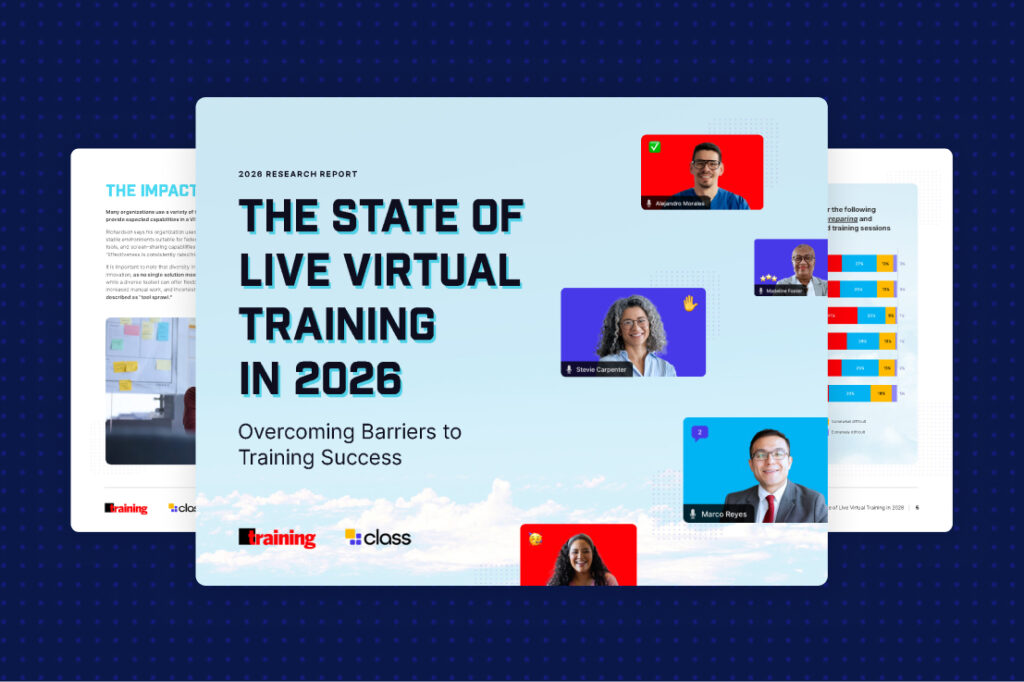
This year, in partnership with Training magazine and Microsoft, we released research based on insights from more than 650 L&D and training professionals. The findings reinforce a clear takeaway: VILT is widely adopted, and learner engagement remains the biggest opportunity for improvement, with 72% of respondents citing learner engagement as their top challenge in VILT.

Training leaders also pointed to the tools they want most to improve outcomes, including engagement analytics, enhanced breakout rooms, built-in assessments, and better participation monitoring. This aligns closely with our product direction and our continued focus on building a virtual classroom designed for effective live learning.
And we’re continuing to invest in research that helps learning leaders navigate what’s next. In February 2026, we’ll be releasing a new report with Training magazine on the state of virtual instructor-led training, building on what we’ve learned from working with organizations across industries. We’re looking forward to sharing what the data shows, where VILT is heading, and what it will take to deliver more engaging, consistent training at scale.
In 2026, we will continue building toward a more complete learning journey, supporting what happens before, during, and after live virtual learning sessions.
One of the areas we are most excited about is session planning, which will help facilitators prepare more effectively and deliver more consistent learning experiences. Building on LMS integrations and our Class templates, this work will focus on making it easier to structure a session, organize activities and breakout rooms, and launch instruction with clarity and confidence.
We are also continuing to expand our reporting and analytics, helping learning leaders evaluate effectiveness across programs, support instructors, and improve learner outcomes over time.
This is how VILT becomes more scalable, more consistent, and more impactful.
To our customers and partners, thank you for trusting Class and shaping our product through your feedback and collaboration. To our team, thank you for the energy and focus you brought to this work throughout 2025.
We believe virtual instructor-led learning can be one of the most powerful ways to deliver training and instruction. When it is designed well and delivered through a world-class solution, it can be engaging, measurable, and deeply human.
We are proud of what we delivered in 2025, and we are even more excited about what comes next. If you’d like to learn more about what’s ahead and what it could mean for your live virtual learning programs, I encourage you to connect with our solutions team.
Here’s to an impactful year ahead. Let’s get back to Class and make 2026 our best year yet.